Built for Greatness: The Reason Behind Our Coaching Journey
If you’re anything like me, you’ve probably had moments where you look at your life and think… how did I get here?
Not just the good parts. I mean all of it.
The things that stretched you. The things that hurt. The things that made you question yourself. The things you would never go back and choose again.
And at the same time, there’s this quiet awareness that those very moments shaped who you are today in ways you can’t ignore.
That’s really where this conversation begins.
Because before there was coaching, before there was growth, before there was any kind of intentional path forward, there was just life happening. And for both of us, life didn’t show up in some perfectly packaged, easy-to-navigate way. It showed up in experiences that forced us to decide how we were going to see them and what we were going to do with them.
And I think that’s something a lot of people don’t talk about enough.
Two Different Starting Points
One of the things I found really interesting in this conversation is how different our starting points were, even though we ended up moving in a similar direction.
Shunta talks about always having this belief that she was built for greatness, even as a kid, even while going through things that most people would look at and say, “That’s unfair” or “That shouldn’t have happened.” But instead of seeing those experiences as something that was working against her, she saw them as something that was preparing her for something bigger.
I didn’t have that same belief growing up.
I wasn’t walking around thinking I was built for greatness. What I did know, very clearly, was that I did not want the life I was watching unfold around me, and somewhere along the way I made a decision that I was going to prove people wrong.
And if I’m being honest, that became fuel for a long time.
Different perspective. Same movement.
That’s the part I want you to catch, because there isn’t just one way to move forward. There isn’t one “right” mindset you have to have in order to grow. What matters is that you don’t stay stuck in the meaning you were handed.
What You’ve Been Through Doesn’t Disappear
Here’s the reality.
Your past doesn’t go away.
It shows up in how you think, in how you respond, in what you expect from yourself and from other people. It influences what you notice and what you ignore. It shapes what feels normal to you.
And for a long time, that can feel like something you’re carrying.
Something heavy.
Something you’re trying to outrun or outgrow.
But there’s a shift that happens when you stop trying to pretend it didn’t matter and instead start asking a different question.
Not “Why did this happen?” but “What do I want to do with this now?”
That question changes everything, because it puts you back in a position of choice.
There’s a Moment Where You Realize You Want More
For both of us, there was a point where life was already good.
Not perfect, but good.
And still, there was this sense of… is this it? Or is there more?
That’s actually when coaching entered the picture.
Not from a place of everything falling apart, but from a place of wanting more clarity, more intention, and more direction. Wanting to understand how to take everything we had been through and actually use it in a meaningful way instead of just carrying it forward.
And what surprised me the most is how quickly things started to shift once that decision was made.
Because when you have someone who is willing to ask you better questions, challenge your thinking, and help you see what you can’t see on your own, things start to move differently.
You stop circling the same thoughts.
You stop getting stuck in the same patterns.
And you start making decisions with a level of awareness that wasn’t there before.
You Start Paying Attention to What You’re Letting In
One of the biggest changes that comes with growth is realizing how much influence your environment actually has.
Not just your physical environment, but what you’re consuming every day.
What you’re listening to first thing in the morning. What you’re watching before you go to bed. The conversations you’re having. The people you’re around.
All of it matters.
Because if you’re constantly feeding your mind fear, negativity, and noise, it’s going to show up in how you think and how you feel, whether you realize it or not.
At some point, you have to take ownership of that.
You have to decide what you’re going to allow in and what you’re not.
That’s not about ignoring reality. It’s about being intentional with your focus.
You Learn to Interrupt Your Own Thinking
There’s something else that shifts as you grow, and it’s not always talked about in a practical way.
You stop just listening to whatever shows up in your head.
And you start talking to yourself differently.
That might sound simple, but it’s not always easy.
Because your default thoughts are shaped by everything you’ve been through, and they don’t always serve you. They can pull you back into old patterns, old beliefs, old reactions.
But when you start noticing them, and you start choosing how you respond instead of automatically reacting, that’s where change actually happens.
Not in one big moment, but in small, consistent decisions.
The People Around You Matter More Than You Think
Another thing that became really clear through this journey is how important the people around you are.
And I don’t just mean having people in your life.
I mean having the right people in the right roles.
People who support you. People who challenge you. People who guide you. People who are walking alongside you.
Because you can have a lot of people around you and still feel stuck if those roles aren’t being filled.
And the truth is, those people will change over time.
Different seasons require different support.
Which means you have to be willing to check in with your circle and ask yourself if you’re surrounding yourself with what you actually need right now.
This Is Where It Becomes Personal
At some point, this stops being about learning new information.
It becomes about how you live.
How intentional you are with your time, your energy, and your focus.
How you respond when things don’t go the way you expected.
How you keep moving forward even when it would be easier to stay where you are.
That’s what coaching really is.
It’s not about fixing you.
It’s about helping you see what’s already there and supporting you as you step into it more fully.
What I Want You to Take From This
If this is the first time you’re hearing us, I want you to understand something.
You’re not behind.
And you’re not disqualified because of what you’ve been through.
If anything, the experiences you’ve had are part of what makes you capable of more.
The question is whether you’re going to keep looking at them as something that holds you back, or start seeing them as something you can build from.
Because once that shift happens, everything else starts to move.
And that’s really what this conversation is about.
Not just where we’ve been, but why it matters, and what you can do with your own story moving forward.
Chapter List:
00:00 Welcome + Why This Conversation Matters
01:00 What Led to Becoming a Coach
02:30 “Built for Greatness” and Reframing Your Past
04:30 Childhood Experiences and What They Create
06:30 Turning Pain Into Purpose
08:30 Mindset: Stop Listening, Start Talking to Yourself
10:30 What You Consume Shapes Your Thinking
12:00 The Power of Coaching and Personal Growth
13:30 The 5 People Everyone Needs in Their Life
16:00 Final Thoughts + Where to Find Support
Full Transcript:
Kimberly (00:01)
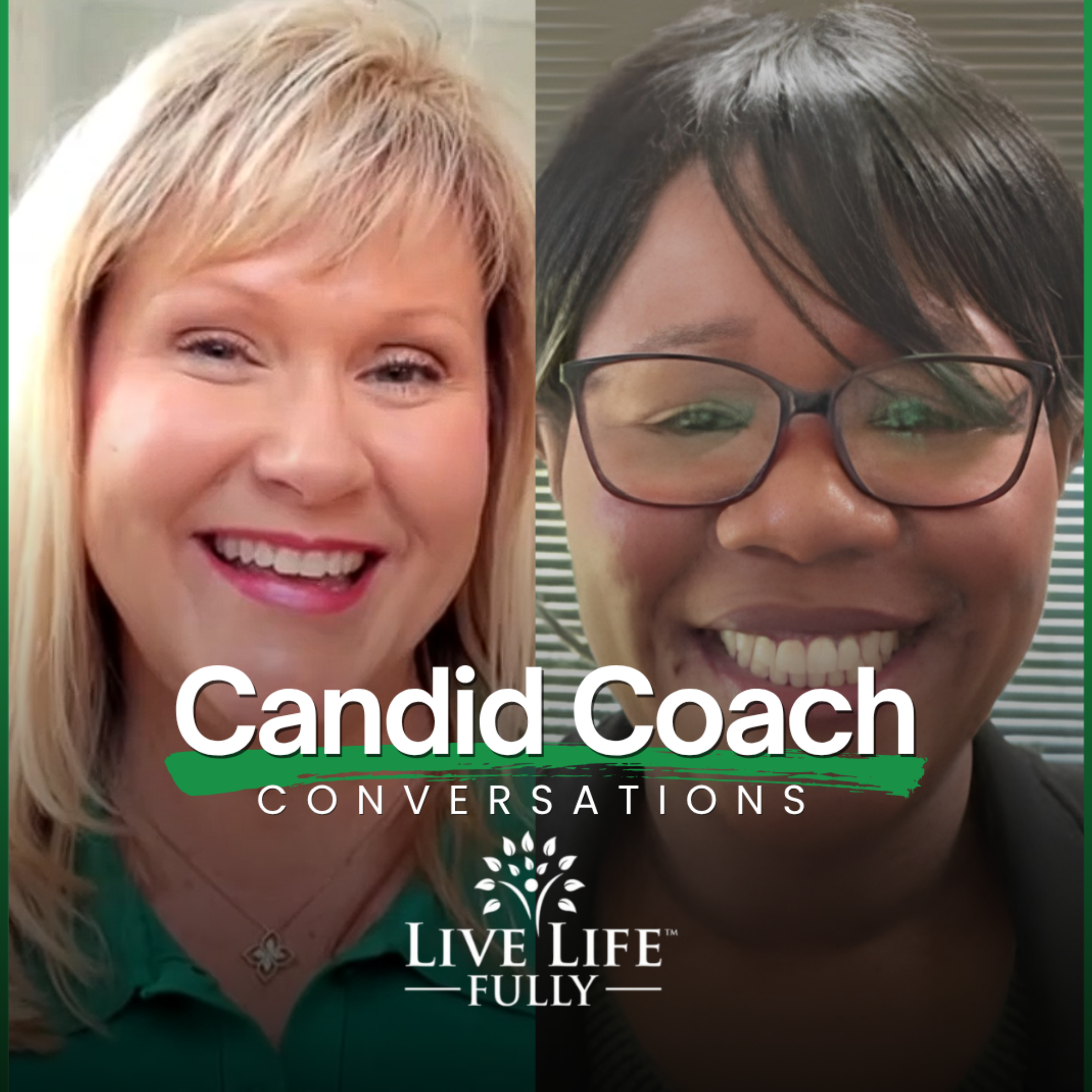
Hello again and welcome to Candid Coach Conversations. I'm Kimberly Boyd.
Shunta (00:06)
And I'm Shunta Montgomery.
Kimberly (00:08)
And we're glad you're here today. my gosh, welcome back Shunta. I'm glad you hopped on. I'm glad to see you and welcome to all the viewers and listeners. I have a question for you Shunta. Super curious.
Shunta (00:21)
might have an answer.
Kimberly (00:24)
So what I know is that you've been in the mental health world for a while, you're a licensed professional counselor, you've got kiddos, you've got a husband, you've got grandkids, you do not have dogs, and you decided to become a certified Live Life Like coach.
So what I want to know is what led you to the decision to become a certified Live Life Flight Coach?
Shunta (00:46)
Well, when I made that decision, first of all, when I made the decision to actually hire a coach, it was during the time I just graduated, not just graduated, just finished my hours. I had went to Growth Day, came back from Growth Day, and I was like, okay, now what? And so the coaching opportunity presented itself. I was like, okay, this is gonna help me with my now what?
And then I got so much from our coaching sessions where it propelled me not to just nail wood, but like my future, my purpose, you know, creating my generational wealth. I always knew that I was built for greatness. I just never knew how I was going to get to greatness. And I believe coaching has helped me get to greatness to that next level.
Kimberly (01:37)
I think that is incredible. my gosh, and thank you for sharing. And when you say, I always knew I was built for greatness, tell me what you mean by that.
Shunta (01:46)
Well, I believe that I've been through so much in my life and I have looked at it so differently. Not that I'm any different from anyone else. It's just I look at it differently. Like even as a young age when I was going through it, I was just had this mentality that there must be a greater reason why I'm going through this and I'm not going through this for myself. And so I just believe I went through so much-ish.
as a kid that there has to be a bigger, better plan for me. God is out there like preparing me for greatness because of what I went through as a kid.
Kimberly (02:25)
my gosh, I love that. So what I'm hearing, and I don't know who said this first, and I do love it, is that even as a kiddo, you are not seeing it as this is happening to me, but it is happening for me, because it was like the pearl, like it was getting you ready to become the amazing Shantae.
Shunta (02:46)
Absolutely.
Kimberly (02:47)
I love it. And I'd love to share too, as you were talking, I was like, so growing up, I did not know for sure that I was built for greatness and.
What I did know for sure is I was going to prove people wrong. So as a little girl, as far back as I can remember, my dad would ask me questions like, will you ever amount to anything? If I was asked that once, I was asked that a bazillion times.
And I paused because I'm like, I don't even know what bazillion is. Anyway, that doesn't matter. Okay, but I was asked a lot if I'd ever amount to anything. And then the other question he was asked is he would say, Kimberly, what are we going to even do with you? Maybe we should just put you in the trash can. So those comments started, like I said, as far back as I can remember. And I don't know. don't think he was trying to be ugly.
Although looking back, I'm like, who says that to a person? So, but then growing up in the home that I grew up in, there was lots of domestic violence. My dad was an alcoholic and he was a pharmacist. And back then they didn't have all the rules like we have today. And so when you owed your own pharmacy, he had free access to pills. So he was on pills, which pills and alcohol does not equal a super kind person.
Shunta (03:45)
Yeah.
Kimberly (04:11)
So, but so going back to what you were saying, like you always knew you were built for greatness. And while I don't think I always thought I was built for greatness, I did know for a fact that I did not want to live the life that my mom lived with my dad. And I was going to amount to something because I was going to prove him wrong. So similar and yet different. Yeah. So I just think it's fascinating.
Shunta (04:34)
So Kimberly, I have a question for you. Do you believe that had you not been through what you went through, you would become the person that you are now?
Kimberly (04:35)
Okay.
No, I don't. mean, of course I don't have a crystal ball that looks backwards or forwards. Dang it. I do have a crystal ball. I do have a crystal ball. It sits in my window in the kitchen and it doesn't show me anything in the future. In fact, when you look through my crystal ball, whatever's in front of it, like in this case would be the lake and then trees, everything's upside down when you look at the crystal ball. So weird.
Shunta (04:52)
Absolutely. Well, you have a crystal ball.
Kimberly (05:11)
But no, I truly think I don't want to repeat my childhood, not even for a second. And I'm thankful for all of it because I do think that that is what has given me my passion for children and the well-being of kids. Because I don't, I mean, clearly kids don't get to pick their parents. They don't get to pick their parents' decisions.
So I do think that my childhood instilled that passion that I have for children and...
I know it was a motivator. My friend Christian Moore, you know, he wrote the book, The Resilience Breakthrough. And in there, he talks about street resilience and it's tell me I can't and I'll show you that I can. And I think I had that mentality. Like my dad says, are you ever going to amount to anything? Yeah, buddy. I'll show you. I will. So, so yeah, I'm thankful.
Shunta (05:54)
Yeah.
And you did.
Kimberly (06:05)
I'm grateful for the past that I had. It did teach me a lot. It taught me the life that I didn't want to live.
It showed me a lot. even I wouldn't wish on anybody. What about you? Do you think the same thing? Like, is your past, has that made you who you are? And your determination and your grit and your stamina and resilience?
Shunta (06:13)
Yeah. ⁓
Absolutely.
Absolutely. I agree. I would never wish for that past, however it happened. And I think that, you know, we made the best of it, right? We're not a victim to our past. We're just like our past happened and we are this person who we are. Kind of reminds me of when you did the speech at the retreat about turning your lessons into blessings.
Kimberly (06:50)
yes, yeah, definitely think so. And with that, think it's important that, or yeah, important and to have an awareness of the mindset. mean...
Do I ever get down and discouraged? Yes, I do. And then I have to talk to myself. Like you said earlier, coaching yourself. I talk to myself, I coach myself, I push myself. Because I think it's a choice, for me anyway, it's a choice. I can choose to stay in this discouragement blah, or I can choose to figure out what's one tiny step I can take forward to get
of the discouragement. One tiny step I can take to get out of the blah that's happening.
Shunta (07:29)
Yeah,
that reminds me of, at this point, I've said it so much. I'm sure I was not the originator. So forgive me for not giving credit to the originator. But the comment that I tell a lot of people a lot of times is stop listening to yourself and start talking to yourself.
Kimberly (07:46)
Hmm. Yes.
Shunta (07:47)
Just like
you said, mindset. I truly believe mindset is everything. And so, yes, we all have a past. We all have history. And so, yes, that past is going to creep up and things are going to come up. However, what are you speaking into yourself? What are you saying to yourself? What even are you listening to? What are you watching? Who are you with? All of that impacts your mindset and what you speak to yourself or how you listen to yourself if you're listening to you.
Kimberly (08:15)
Yes, I often tell people or ask like how often do you watch the news and what time of day do you watch the news? And so people tell me they're watching it when they wake up in the morning and they watch it before they go to bed. I'm like
Shunta (08:28)
You
Kimberly (08:29)
I don't know, but the news, I have not seen a news channel that's just shooting all the joy out. It's usually terrible stories and fear and anger and hatred and just sadness.
So I'm like, if that's what you're listening to, first thing, that's what your brain is hearing. First thing, and if that's the last thing before you go to sleep, your brain's going to sleep with all that stuff on it. Stop that.
Shunta (08:54)
Yeah.
Kimberly (08:55)
And there are studies, it's a research that's been done pretty recently about the news and how often people need to be watching the news. And it's like, if you are a news person, check it one time a day. It really doesn't change that much from noon until six or 10 o'clock. There's just not a whole bunch of change. So one time a day, and if you miss something, you'll hear about it in the community.
Shunta (09:14)
Yes.
And then it's typical, it's in the same category. A murder, a robbery.
Kimberly (09:23)
Right, tune in for the latest.
Shunta (09:26)
You
Kimberly (09:26)
Exactly. Okay, so you became a coach then or decided to become a coach and get certified because of the growth you saw in your own life. Same with me. That is what happened. I had a coach and my life changed rapidly and for the better.
which I already had a really good life, so it was kind of wild. And then I decided, oh gosh, I want to get certified, and then thought, I want more people to coach. I'm gonna write my own certification program and curriculum for coaching. I love coaching. Yeah, I think it's super fun.
Shunta (09:59)
Love that.
You
I agree.
Kimberly (10:09)
Okay, beautiful. I'm glad you popped on again and any last takeaways that you want to share.
Shunta (10:15)
One, I guess I could talk about the five people that is important for everyone to have in their life. And so the first person is a cheerleader and I am going to use my fingers, my hand, fingers, all of this.
Kimberly (10:30)
all of it.
I it.
Shunta (10:31)
And so this is according to Stacey Flowers. She did a TED Talk and so she said, everyone needs to have a cheerleader in their life. You need someone that's going to cheer you on no matter what, be there for you, ups and downs, you got this, you can do it. The next person you need to have in your life is a mentor. And this mentor person is a person that's gonna guide you. So it's someone that is a field that you're trying to get into.
and they're going to guide you, walk you through the next steps and just show you the ropes and show you what to do and how to do it. The next person, don't get offended, but is a coach. And yes, this is the finger that I am using because yes, a coach is the person that's going to stretch you and push you and make you very uncomfortable. When you think about you hire a personal trainer, you hire that personal trainer to coach you.
Kimberly (11:06)
you
Shunta (11:23)
into success for the weight that you want, the body that you want. On the field, and you think about sports, that person is going to push your kid or push you to the fullest potential because they see the potential in them and they want it to show. So that's a coach. So when you think of a life coach, that's our job is to push you to become the greatest person that you can become. And like Kimberly said, she had a great life, but her coach pushed her to have an even greater life.
and to live more intentionally. The next person is a friend. And the reason why she use a ring finger for friend is because when you think about your ring finger, you think about it's connected to your heart. so your friends, they're the ones that's connected to your heart. So they're the ones that know your deepest secrets. You share good times, you share bad times. Those are your friends. And then the last person you need is a parent.
and your peer is just, you you guys are peers, you work at the same job basically, or you go to the same school, and that's just someone that you come in contact with, another term may be an associate. So a peer or an associate. And so those are the five people that everyone should have in their life. And I agree. I think that, and there may be overlap, right? You can have somebody that's a cheerleader and that's also your friend.
Kimberly (12:42)
Yes, I love it. I'm glad you brought that up. I like the reminder. And I think it's important because I think people come and go in our lives.
and for a season and seasons change. And so sometimes your cheerleader will change, your mentor will change. I know for me, when it comes to a coach, I have several coaches and so, and a coach that I had a long time ago isn't a coach with me anymore. So people are gonna change. I don't know, maybe do a check-in as the season changes, like winter, summer, spring, fall, as the season changes, who are the five that you
Shunta (12:53)
absolutely
Kimberly (13:16)
have in your life for that season. And if there's one missing, where do you go to get it?
Shunta (13:21)
Well, I can tell you, live life fully is where you can find a coat.
Kimberly (13:25)
Okay, true. Very true. my gosh, that's incredible. And the retreats, the retreats are fun, super fun and pretty powerful. That's right. Yeah. And incredible people that attend, like to meet new people. Super fun.
Shunta (13:33)
Get access to multiple coaches on that day.
Yes. Yes.
Kimberly (13:42)
Yeah. Okay, Shunta, thank you again for hopping on. Can't wait to see you again soon. And we are wishing everybody a fabulous day. Bye.
Shunta (13:51)
Bye.